
OUR APPROACH
The idea of a living wageLiving wage (as defined by the Anker Research Institute)Remuneration received for a standard work week by a worker in a particular place sufficient to afford a decent standard of living for the worker and her or his family. Elements of a decent standard of living include food, water, housing, education, health care, transport, clothing, and other essential needs, including provision for unexpected events. is that workers – and their families – are able to afford a decent standard of living that is considered acceptable by society at its current level of economic development. A fair compensation approach goes further than this. It considers the fairness of the wage that a worker is paid by benchmarking whether wages meet all legal requirements, are paid in full and on time, reflect a worker’s performance and skills, follow price increases paid for the products they make, are linked to their employer’s profits and sales, are negotiated individually or collectively with the workers and are clearly and formally communicated to them, among other factors.
The workers employed in our supply chain should not have to face hardship in their daily lives. Our aspiration as a responsible business – and as set out in the core principles of our Workplace Standards – is that workers earn enough for themselves and their families’ basic needs and have income remaining to cover discretionary spending as well as savings. We seek business partners who progressively raise employee living standards through improved wage systems, benefits, welfare programs, and other services which enhance quality of life.
OUR AMBITION
TO SEE PROGRESSIVE IMPROVEMENTS ACROSS ALL FAIR COMPENSATION BENCHMARKS AND ACHIEVE GENDER WAGE PARITY FOR WORKERS IN EACH OF OUR CORE TIER 1 SUPPLIERS BY 2025
MEASURING PROGRESS ON FAIR COMPENSATION
Calculating and paying fair compensation within global supply chains is complex. Wages are determined by the general economic conditions and cost of living in a country, by national laws and government policy, and a number of other variables. We recognize we cannot do this alone and continuously seek to work and collaborate with other entities to make fair compensation a reality for workers in the supply chain.
As a member of the Fair Labor Association (FLA), we align our approach with the FLA Benchmarks and their Fair Compensation Methodology. We have also joined the Anker Research Institute (ARI) as a Corporate Sponsor to leverage their technical expertise and broader living wage community. As part of our fair compensation strategy, we have adopted ARI’s living wage definitionARI’s Living Wage DefinitionThis includes key components like food, water, housing, education, health care, transportation, and discretionary income to help deal with unexpected life events. . The elements included in the ARI living wage definition inform ARI’s wage estimates, which we use to assess wage progress using available benchmarks from the Global Living Wage Coalition.
OUR FIVE LEVERS SUPPORTING WAGE PROGRESSION
Our approach to the payment of fair compensation in our global supply chain is built around five levers that influence wage development. For each lever, we have a program of work to support fair compensation and wage progression. The five levers include:

LEGAL OBLIGATIONS
Fair compensation starts with compliance and cannot be achieved without first ensuring factories meet the legally required minimum wages and benefits. We require our suppliers to pay all legally mandated wages and benefits, on time and in full, and we monitor this closely. We also expect equal pay for men and women.

RESPONSIBLE PURCHASING PRACTICES
Our commitment to responsible sourcing and purchasing led to the launch of our Responsible Sourcing & Purchasing Practices Policy at the end of 2017. This policy ensures that our sourcing and purchasing decisions support the adidas Workplace Standards, including how wages are paid to workers, rather than conflict with them. In 2020, we added 10 Buyer Commitments to further guide our responsible purchasing.

PRODUCTIVITY
Calculating and paying fair compensation within global supply chains is a complex issue that is often linked to productivity and efficiency. We support productivity initiatives and technologies that reduce work hours and improve pay for performance. As technology and automation increase demand for skilled workers, we see an opportunity to improve wages and benefits.

GOVERNMENT ENGAGEMENT
Governments have a duty to protect and promote human rights by upholding ILO labor conventions and core principles at work. They play a crucial role in supporting fair industrial relations and ensuring workers can freely organize and bargain collectively. Achieving lasting, sector-wide improvements in wages and welfare depends on active engagement with policymakers and national governments.

INDUSTRIAL RELATIONS
Strong industrial relations are essential for fostering dialogue, transparency, and effective problem-solving between employers and workers. They empower workers to negotiate fair wages and working conditions through collective bargaining -- a right protected under two core ILO conventions: the Freedom of Association and Protection of the Right to Organize (No. 87) and the Right to Organize and Collective Bargaining (No. 98).
DATA COLLECTION
To measure and track wage progress over time, we have continued to use the FLA’s Fair Compensation Data Collection Tool to collect wage data from a sample of our core global suppliers. This data covers three reference years: 2020 (our baseline), 2023 (our mid-point), and 2025 (our final year). The results help us evaluate how wages are evolving, identify priority countries, and understand the influence of our five wage levers.
In 2024, we completed 2023 wage data collection across our six in-scope countries, the results can be found below. For 2020 results, please go here. 2025 wage data will be collected in 2026 and subsequently published in our 2026 Annual Report and on this website. Please stay tuned for updates.
Benchmark Results
We compared the average net wagesNet Wage Formula (as defined by the Fair Labor Association methodology)Net wage includes the basic contracted wage, in-kind and cash benefits, and deducts taxes and other deductions. Net wage does not include incentive or leave wages, unless otherwise specified, and never includes overtime wages. In our data collection samples, we have included incentive and leave wages if they meet FLA applicability requirements. at the factory level for each country against four benchmarks: the legal minimum wageMinimum wage (as defined by ILO)The minimum amount of remuneration that an employer is required to pay wage earners for the work performed during a given period, which cannot be reduced by collective agreement or an individual contract. , the FLA Country AverageFLA Country AverageThis is the average of all wage data reported through the FLA Fair Compensation Dashboard by Dashboard users for the applicable calendar year. This benchmark is only available as a country-wide average. To avoid inaccuracies, we only apply this benchmark in countries where the minimum wage is calculated for the entire country and not by various regions or groups. (where applicable), the GLWC–ARI Living Wage Reference Value or EstimateGLWC–ARI Living Wage Reference Value or EstimateThis is our living wage benchmark. This value is used only where available and relevant to the factory’s location. It reflects the estimated income required for a decent standard of living. , and the World Bank International Poverty LineWorld Bank International Poverty LineAlthough this benchmark measures extreme poverty, and our aim is to move our suppliers further away from it, it is a constant benchmark across all applicable countries which allows us a cross-country comparison. It is shown in gross terms. . Although the figures exclude overtime, we also collected and presented that data to offer a more complete picture of take-home pay. The results are based on factory averages, meaning some workers earn more and others earn less; however, in all cases, legal minimums were met. All amounts, except for the minimum wage and the World Bank International Poverty Line benchmarksWorld Bank International Poverty LineUnder FLA's methodology for calculating the World Bank International Poverty Line benchmark, the daily poverty line used to derive the monthly benchmark was updated between reporting cycles. The 2020 wage data was assessed against the 2011 PPP poverty line of $3.10/day, while the 2023 wage data was assessed against the updated 2017 PPP poverty line of $3.65/day. In both cases, the daily rate is converted to a monthly benchmark. As a result, comparisons between 2020 and 2023 results may be affected by this methodological change and should be interpreted accordingly., are in their net format (excluding legal deductions).
The factories within our data collection scope sit within nine different minimum wage groups. Due to the deactivation of one factory, there is one minimum wage group fewer than in 2020. In 2023, minimum wage requirements in China ranged widely from between CNY 1,550 to CNY 2,280.
Our data collection for 2023 shows:
- Across all minimum wage groups, net wages exceeded the respective minimum wage requirement by 16% to 178% (2020: 13% to 159% respectively); which helped support higher basic wages.
- There was one applicable region with an available GLWC-ARI Living Wage Estimate (2020: two regions). In this region, factory net wages exceeded the GLWC-ARI benchmark by 57% (2020: 34%).
- The World Bank International Poverty Line was exceeded by 112% to 481% (2020: 119% to 454%).
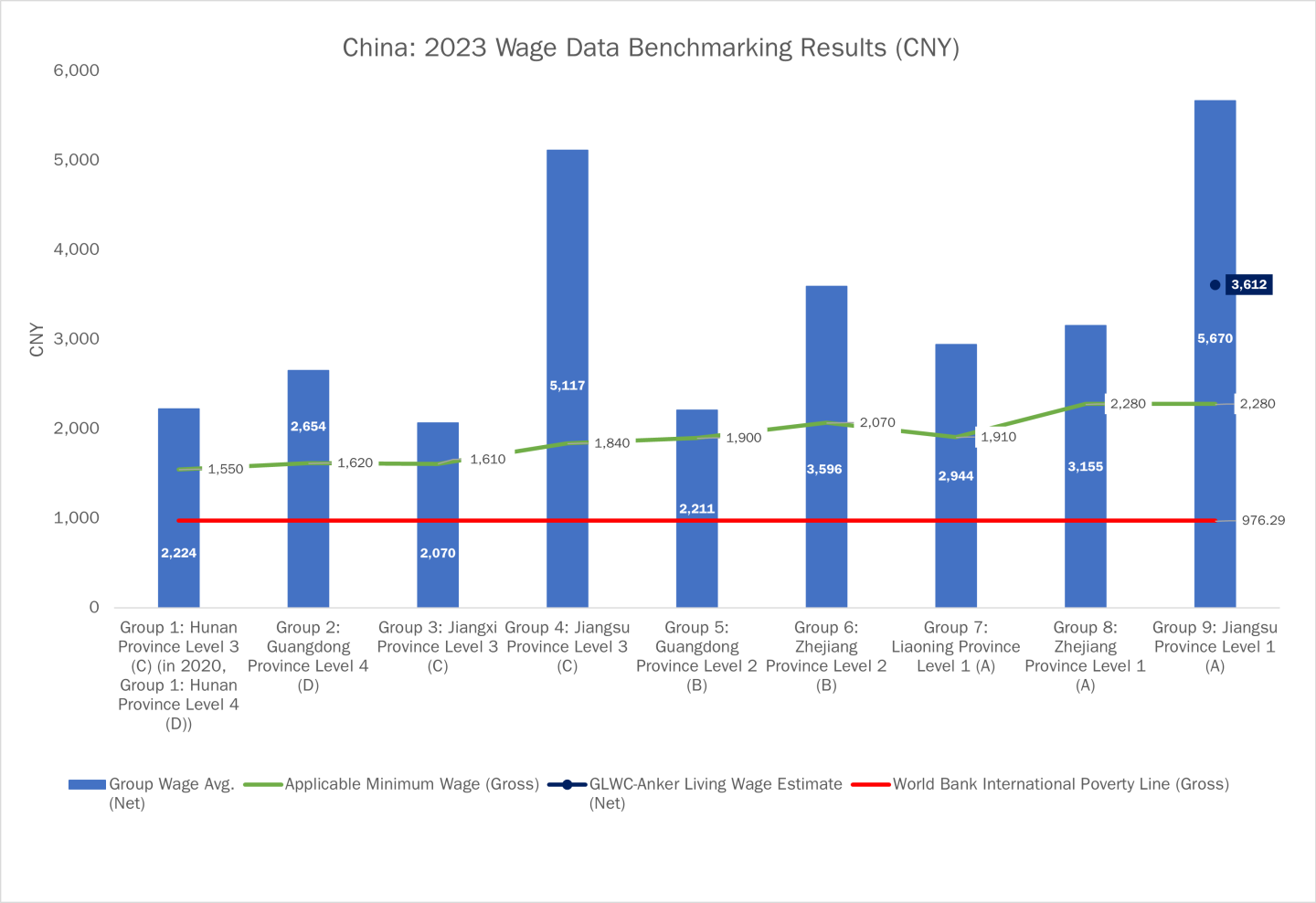




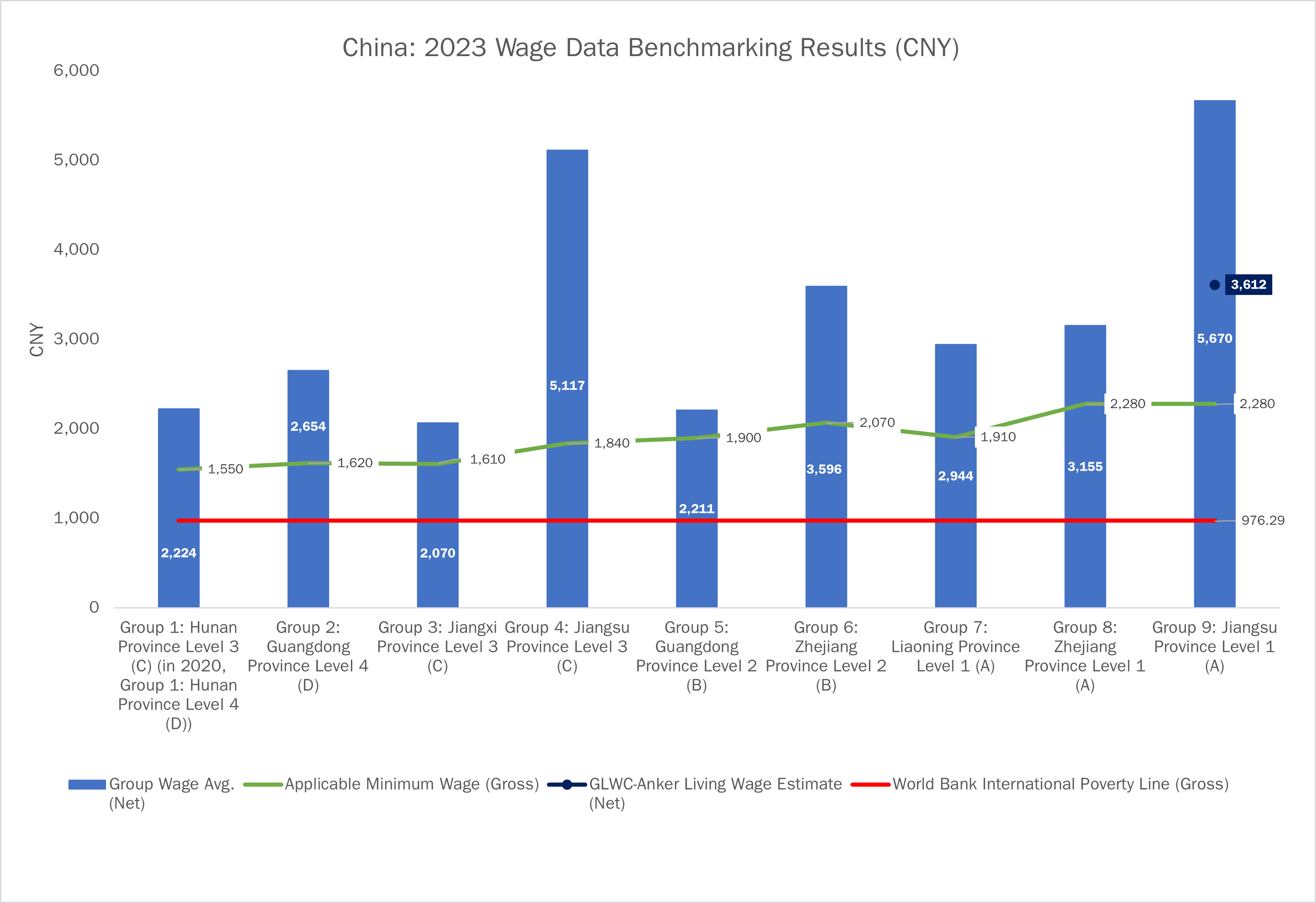
Group No | 2023 Group Net Wage Avg. (CNY) | Net Wage vs. | Net Wage vs. GLWC-ARI Living Wage Estimate (Net) | Net Wage vs. World Bank International Poverty Line (Gross) |
|---|---|---|---|---|
Group 1: Hunan Province Level 3 (C) (in 2020, Group 1: Hunan Province Level 4) | 2,224 | Exceeded by 43% | N/A | Exceeded by 128% |
Group 2: Guangdong Province Level 4 (D) | 2,654 | Exceeded by 64% | N/A | Exceeded by 172% |
Group 3: Jiangxi Province Level 3 (C) | 2,070 | Exceeded by 29% | N/A | Exceeded by 112% |
Group 4: Jiangsu Province Level 3 (C) | 5,117 | Exceeded by 178% | N/A | Exceeded by 424% |
Group 5: Guangdong Province Level 2 (B) | 2,211 | Exceeded by 16% | N/A | Exceeded by 126% |
Group 6: Zhejiang Province Level 2 (B) | 3,596 | Exceeded by 74% | N/A | Exceeded by 268% |
Group 7: Liaoning Province Level 1 (A) | 2,944 | Exceeded by 54% | N/A | Exceeded by 202% |
Group 8: Zhejiang Province Level 1 (A) | 3,155 | Exceeded by 38% | N/A | Exceeded by 223% |
Group 9: Jiangsu Province Level 1 (A) | 5,670 | Exceeded by 149% | Exceeded by 57% | Exceeded by 481% |
OTHER FACTORY CHARACTERISTICS
APPLYING OUR LEVERS
LEGAL OBLIGATIONS
LEGAL OBLIGATIONS
Beyond individual factory compliance, we monitor supplier performance and take enforcement action when standards are not met. Where systemic wage challenges exist, we take targeted action at the country level. Below are two examples where we applied this lever to address broader wage-related issues:
- Mexico – Overtime Pay (OT): Together with other participants in the Americas Group initiative, adidas supported the drafting and implementation of a memo requiring overtime premiums to be based on full integrated wages, including incentives and benefits, rather than based on hourly wages. After verifying Tier 1 supplier compliance, we expanded enforcement to Tier 2 suppliers.
RESPONSIBLE SOURCING & PURCHASING PRACTICES (RPP)
RESPONSIBLE SOURCING & PURCHASING PRACTICES (RPP)
To better understand and improve the impact of our Responsible Purchasing Practices (RPP), we actively seek feedback from our manufacturing partners, both anonymously and openly. We do this through subscription to the Better Buying InstituteBetter Buying Instituten organization that assesses and reports on the purchasing practices of participating brands. Better Buying was acquired and is managed by Cascale as of 2025(BBI) and through our own engagement with our suppliers. Based on this feedback, we have implemented several RPP improvements related to fair compensation, including:
- Enabled greater transparency on demand forecasts to help suppliers plan ahead. This includes monthly market forecasts, qualitative outlooks, and an annual capacity roadmap (at least two seasons forward). These forecast refresh help suppliers plan for their P&L and budget to pay workers on time and in full.
- In 2025, we updated our standard lead times for Apparel to give suppliers more flexibility, more accurately reflect material preparation time, and bring us in line with industry standards.
- Revised costing framework to better reflect inflation in overhead calculations. Seasonal wages adjustment discussed and agreed with each supplier partner we work with.
- Provided greater visibility into existing financial support programs such as prepayment options and vendor financing programs.
- Actively facilitated collaboration between Tier 1 and Tier 2 partners by sharing key information such as material usage in products, forecasts, and delivery plans. For example, in 2025 we hosted a material availability workshop with Apparel Tier 1 and Tier 2 partner to exchange best practices, address major challenges, and explore opportunities for improvement.
- We are continuously working on simplification projects that target to simplify the ways we work and create more efficient processes for both us and our suppliers.
- Adopted new ways of working that give suppliers greater ownership and self-governance, along with clear expectations and transparent guidelines.
Furthermore, in partnership with BBI, we launched our e-learning training on RPP for more than 4,000 employees across our organization in 2023. To reinforce and expand this effort, a refresher training will be launched in 2026 for all Product Development & Sourcing team members to ensure the information remains top of mind.
PRODUCTIVITY
PRODUCTIVITY
We understand that fair compensation across our global supply chain is closely tied to productivity and efficiency. As part of our efforts, we continue to explore ways to align productivity gains with wage growth. We are also focused on harnessing the benefits of technology to improve operations, while carefully considering its impact on jobs and evolving work environments.
From 2022-2024 we participated in an FLA-sponsored pilot in Vietnam making use of our productivity lever amongst other fair compensation levers:
- Vietnam – FLA Pilot: Between 2022 and 2024, adidas participated in an FLA-sponsored pilot project in Vietnam, funded by GIZ’s Initiative for Global Solidarity with field support from the Research Center for Employment Relations (ERC). The project aimed to enhance responsible purchasing and production practices, social dialogue, and wage progression. FLA reviewed adidas’ RPP policies, factory management and compensation systems, and worker-management communication on wages and benefits. In 2024, adidas submitted its final remediation plan. A summary of the Pilot report may be found here.
INDUSTRIAL RELATIONS
INDUSTRIAL RELATIONS
The path to improving the general welfare of workers is supported by the creation of wage-setting mechanisms that are transparent and have been developed with the direct input of workers. Ideally, this occurs through negotiation or collective bargaining with established and freely elected trade unions, or through alternative legal means, such as workers’ councils or welfare committees. learn more about how we support stronger Industrial Relations in our supply chain, please visit our Freedom of Association and Industrial Relations section under the “Workers in the Supply Chain” page.
GENDER PAY PARITY
GENDER PAY PARITY
To support our gender pay parity ambitions, in 2025 we launched a dedicated Gender Pay Parity e-learning course commissioned by adidas and another FLA Participating Company, in collaboration with the Anker Research Institute and improvingworklife. The course was designed to build supplier capacity, strengthen understanding of the drivers of gender-based pay disparities, and promote equitable compensation practices. In 2025, the course was rolled out to 70% of our in-scope Tier 1 core suppliers, providing participating suppliers with a foundation to better understand potential drivers of gender pay gaps and identify areas for action.
In 2026, we will extend the e-learning to the remaining Tier 1 core suppliers. Building on this foundational training, we will also develop practical Gender Pay Parity tools to support suppliers in assessing potential pay disparities, identifying underlying causes and developing appropriate actions. These tools are expected to form the basis of a Gender Pay Parity Toolkit to be implemented across our Tier 1 core supplier base in 2027. Through this multi-year effort, we aim to strengthen supplier capacity to identify and address gender-based pay disparities and support progress toward greater pay equity in our supply chain.
OUR PROGRESS

We launched a Gender Pay Parity e-learning program across 70% of our in-scope Tier 1 suppliers to strengthen awareness of gender-based pay disparities and build supplier capacity to assess and address pay gaps. Developed in collaboration with the Anker Research Institute and improving worklife, the initiative forms part of a multi-year effort to support more equitable compensation practices and advance gender pay parity across our supply chain.
1 / 15
OUR PROGRESS
We launched a Gender Pay Parity e-learning program across 70% of our in-scope Tier 1 suppliers to strengthen awareness of gender-based pay disparities and build supplier capacity to assess and address pay gaps. Developed in collaboration with the Anker Research Institute and improving worklife, the initiative forms part of a multi-year effort to support more equitable compensation practices and advance gender pay parity across our supply chain.
1 / 15