
Major developments Q3 2026:
- Revenues up 9%, leading to record net sales of € 7.3 billion
- Currency-neutral revenues up 7%, reflecting double-digit growth in almost all markets
- DTC sales grow 17% with strong increases in all markets as strong sell-out trends continue
- Gross margin improves 2.5 percentage points to 54.3%, reflecting tariff refund as well as healthy full-price sales
- Marketing investments normalizing as planned after World Cup
- Operating profit up 37% to € 1.0 billion, the highest quarterly profit on record
- Operating margin increases 2.8 percentage points to 13.9%
- Net income from continuing operations increases 48% to € 711 million
- Inventory position reduced as planned to € 5.7 billion with healthy composition
Major developments 9M 2026:
- Currency-neutral revenues increase 11%, driving net sales to € 20.6 billion
- Operating profit up 21% to € 2.3 billion, reflecting operating margin improvement of 1.0 percentage points to 11.1%
- Share buyback in the amount of € 1 billion executed and 6 million shares cancelled
Increased profit outlook for FY 2026:
- Currency-neutral revenues expected to grow between 9% and 10%
- Operating profit now expected to increase to around € 2.5 billion (previously: around € 2.3 billion)
adidas CEO Bjørn Gulden:
“A great quarter for adidas. We achieved the highest revenue ever in a quarter with € 7,252 million and the highest operating profit ever with € 1,008 million. Our brand, our product and our people are our strength. All markets, with the exception of Europe, grew double digit and DTC grew 17% globally. All this is proof that the adidas brand is doing well around the world!
The investment and creativity in our marketing have created brand heat and again made us an attractive brand globally. Our investment in innovation is paying off, not only by great wins, stories and performances, but also with strong and profitable growth in Football, Running and Training. Our fantastic designers and development teams have created new apparel collections that are globally in high demand and currently fueling our lifestyle business. Yes, the footwear lifestyle business is currently challenging, mainly due to too much inventory and too much discounting in the marketplace, but we know this will soon normalize again. In this environment we are not trying to maximize the short-term. Instead we remain disciplined, continue to strengthen our foundation for sustainable and profitable growth and stay focused on our mid-term targets.
We need to be close to the consumer and their local culture and we are convinced the only way you can achieve this is by empowering our teams in the markets! That is why people are so important and why our people are our main asset. I cannot thank them enough for what they are doing. Regardless of where we go in the world, we see talented adidas people who show an enormous energy, a huge focus on serving our consumer and athletes, a passion for our brand and the company, and a fantastic spirit. In a volatile and complicated world, it is a privilege to work with such a great team.
With everything we have achieved so far this year and with what we see in the pipeline, we feel comfortable that we will deliver full-year sales growth of almost € 2.5 billion and that we will improve the operating profit to around € 2.5 billion as promised. We have what it takes for 2026 – and also for 2027.”
Third-quarter results
Revenues up 9% to record level of € 7,252 million
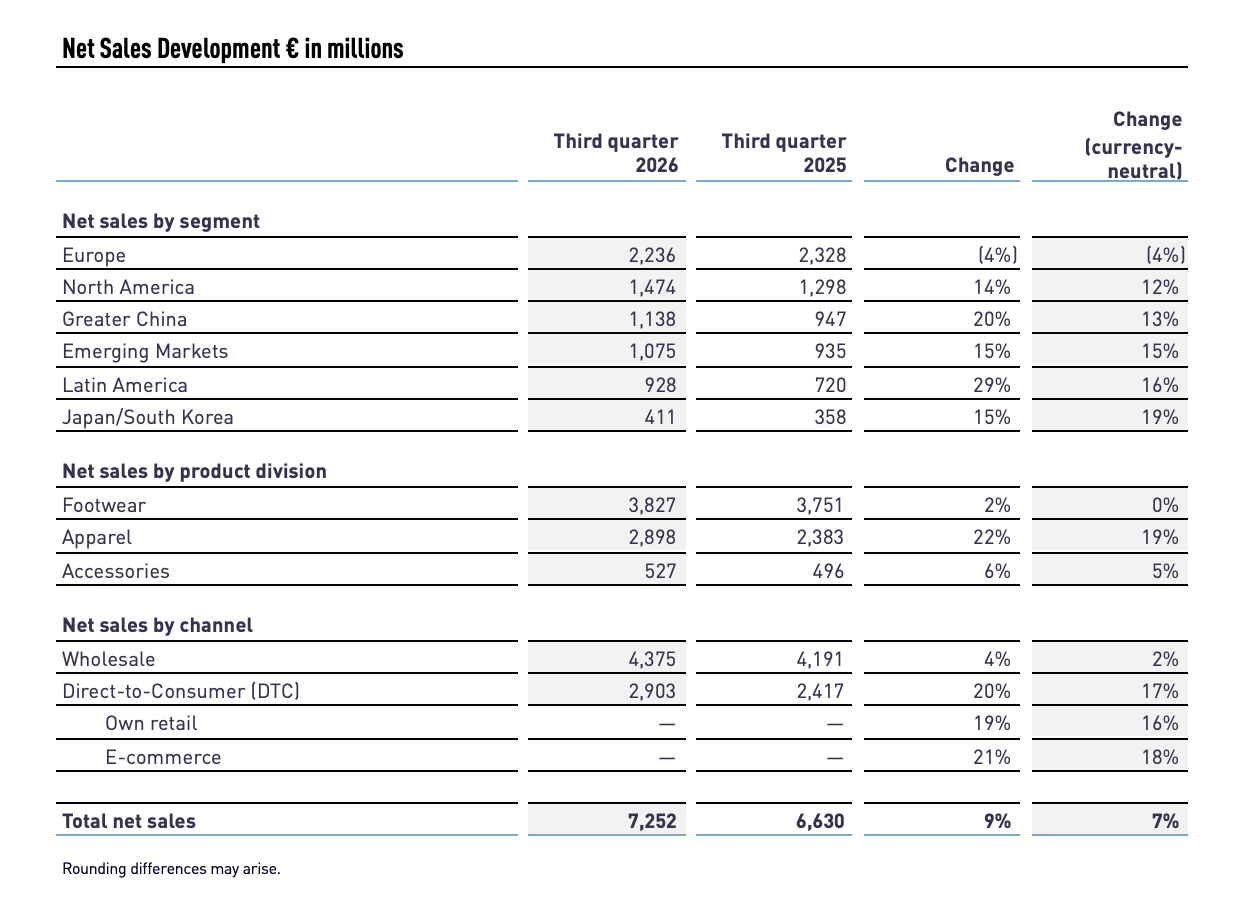
In the third quarter of 2026, revenues grew 9% to € 7,252 million (2025: € 6,630 million), reaching a new quarterly record level. In currency-neutral terms, revenues increased 7% versus the prior year with a continued focus on high-quality growth.
Growth led by double-digit increase in apparel
Apparel revenues increased 19% on a currency-neutral basis in the third quarter, reflecting strong and broad-based demand for the brand’s offering across Performance and Lifestyle. Growth was driven by strong double-digit increases in Originals and Football, next to broad-based apparel growth in many other categories including Sportswear, Running, and Training. Footwear revenues were flat as the company continued to manage wholesale sell-in conservatively to protect its full-price product franchises within a promotional marketplace. In its direct-to-consumer (DTC) channels, the company recorded 6% footwear growth, reflecting double-digit increases in Running and Training as well as growth in many Lifestyle footwear franchises. Accessories also grew and were up 5% during the quarter.
Broad-based growth across Performance and Lifestyle
Performance revenues were up 14% on a currency-neutral basis in the third quarter, driven by double-digit growth in Running, Training, and Football. In Running, the Berlin Marathon marked another highlight as adidas athletes claimed all six podium spots wearing the Adizero Adios Pro Evo 3. The successful race weekend further reinforced the performance credentials of the Adizero franchise and supported the launch of the Adizero Adios Pro 5, the latest iteration of adidas’ race-day franchise for distance running. The brand’s innovation is also making a difference in Running apparel, with Climacool+ 3D keeping runners cool and Techfit Pro providing targeted muscle support. adidas further expanded its offer for everyday runners looking for comfort with the Hyperboost Run, adding another dimension to the new Hyperboost franchise. In Training, the first Originals Sport collection for her, which brings the brand’s iconic Trefoil aesthetic to the gym, recorded exceptional sell-out rates. Additional drops and new colorways of the Adizero Dropset Elite and Pro models, which form the core of adidas’ hybrid racing shoe lineup, continued to drive momentum across strength and hybrid training. In Football, adidas was able to carry the momentum of an all-adidas final at the FIFA World Cup 2026 into the start of the new club season, with successful kit and fan merchandise launches for its major clubs including FC Arsenal, Real Madrid, FC Bayern Munich, Liverpool FC, and Manchester United. Growth in Performance was further supported by increases in several other categories. In Motorsport, localized collections such as the Singapore-themed Vanda Bloom Collection added to the commercial success of the category. In US Sports, first collections for the brand’s new NCAA partners University of Tennessee and Penn State University drove strong demand across an offering spanning more than 20 varsity sports. In addition, Outdoor, Tennis, and Golf also recorded increases in the quarter.
In Lifestyle, revenues rose 3% during the quarter, with growth led by double-digit increases in Originals apparel. Following consumers’ preferences and further capitalizing on the strong momentum for Firebird and adicolor, adidas expanded the ranges with new prints such as checks and seasonal materials including corduroy. Dressier, collegiate-inspired interpretations, including blouson track tops, pleated pants, as well as suede and satin jackets, also resonated strongly with consumers. The newly launched adiSignature line added a modern take on the comfortable everyday style. Collaborations with Jennie, Arte Antwerp, and Simone Rocha further increased the visibility of the brand’s apparel offering. In Lifestyle footwear, within a marketplace characterized by elevated inventory levels and promotional activity, the brand maintained high relevance while at the same time continuing its disciplined sell-in approach to protect its full-price business. On the classics side, Superstar as well as Low Profile continued to grow strongly, as launches such as the Bad Bunny F50 Ghost Sprint and new prints, materials, and dressier iterations of the Japan and Tokyo continued to be well received by consumers. Seasonal updates to the Samba and the Handball Spezial – including ballet-inspired, slipper-like, and double-laced versions – continued to see particularly strong consumer interest. New colorways of the Adistar and new versions of the Megaride, including another collaboration with Willy Chavarria, drove growth in the brand’s running lifestyle business. In Sportswear, the company’s commercial range continued to resonate, complementing the overall offering with sport-inspired products that feature refined and comfortable materials at more accessible price points.
Double-digit DTC growth reflecting strong consumer demand for adidas around the world
Currency-neutral net sales in the direct-to-consumer (DTC) channel grew 17% in the third quarter, reflecting strong demand across the brand’s product portfolio around the world. E-commerce revenues were up 18% and own retail revenues rose 16%, with double-digit like-for-like growth across all store formats. A continued focus on full-price sales resulted in further gross margin improvement in the DTC business. Wholesale revenues increased 2%, as adidas maintained a conservative sell-in approach, especially in Europe, reflecting the uncertain consumer environment as well as high inventory levels and promotional activity in the marketplace.
Double-digit growth in almost all markets
Currency-neutral net sales grew at double-digit rates in Greater China (+13%), North America (+12%), Latin America (+16%), and Japan/South Korea (+19%). In Emerging Markets, revenues increased 15%, despite sales in several Middle Eastern countries being impacted by the conflict in the region. All of these markets posted strong double-digit growth in DTC. Revenues in Europe declined 4%. DTC trends also remained strong in Europe, resulting in high-single-digit growth in the company’s own channels. At the same time, the company’s wholesale business in Europe was impacted by the company’s conservative sell-in approach amid high inventory levels in the marketplace and promotional activity in the lifestyle footwear market. In addition, the successful SAP ERP migration in parts of Europe temporarily impacted wholesale deliveries at the end of Q3 as planned, with the related shipments and revenues now falling into Q4. Both the timing shift of revenues and higher wholesale sell-in are expected to lead to high-single-digit gro
Gross margin increases 2.5 percentage points to 54.3%
The company’s gross margin increased 2.5 percentage points to 54.3% in the third quarter (2025: 51.8%). During the quarter, adidas received the majority of its US tariff claims. The company recorded a corresponding refund of around € 200 million, which contributed to the gross margin improvement. In addition to the tariff refund, the strong gross margin development was driven by healthy full-price sales and a favorable channel mix. Unfavorable currency developments and higher US tariffs had a negative impact on the gross margin development.
Marketing and distribution investments normalizing as planned after World Cup
Other operating expenses increased by 8% to € 2,952 million (2025: € 2,740 million) in the third quarter. As a percentage of sales, other operating expenses decreased 0.6 percentage points to 40.7% (2025: 41.3%). Marketing and point-of-sale expenses were up 4% to € 833 million (2025: € 798 million). The development reflects additional brand investments around the World Cup throughout July as well as marketing spend normalizing since August as planned. Capitalizing on the World Cup opportunity, adidas achieved unrivaled brand visibility around the all-adidas final and Spain’s second Men’s World Cup title win. Other highlights included a strong brand presence around the Berlin Marathon and other major races as well as support for the launch of the Adizero Adios Pro 5 in Running and the Originals Sport collection in Training. As a percentage of sales, marketing and point-of-sale expenses were down 0.5 percentage points to 11.5% (2025: 12.0%), consistent with the company’s plan for the full-year ratio to be below the prior-year level of 12.4%. Operating overhead expenses increased 9% to € 2,118 million (2025: € 1,943 million) as a result of higher e-commerce shipping volumes and the company’s overall strong DTC growth. adidas continued to invest into its sales and distribution capabilities, especially in relation to the World Cup in July, to maintain a high service level despite the high traffic across its DTC business. As a percentage of sales, operating overhead expenses declined 0.1 percentage points to 29.2% (2025: 29.3%).
Operating profit increases to record € 1,008 million
The company’s operating profit increased 37% to € 1,008 million in the third quarter (2025: € 736 million), the highest quarterly level on record, representing an operating margin of 13.9% (2025: 11.1%).
Net income from continuing operations of € 711 million
The company’s net financial expense decreased to € 60 million (2025: € 86 million). While adidas recorded around € 10 million in interest income related to US tariffs, effects related to hyperinflation continued to have a negative impact on the financial result. The company’s tax rate was 25.0% (2025: 25.9%) and net income from continuing operations increased 48% to a record € 711 million (2025: € 482 million), leading to basic and diluted EPS from continuing operations of € 4.06 (2025: € 2.57).
First nine months results
Revenues up 10% to € 20,587 million, driven by strong brand momentum
In the first nine months of 2026, revenues grew 10% and reached a level of € 20,587 million (2025: € 18,735 million). In currency-neutral terms, revenues increased 11% versus the prior year.
Broad-based growth led by apparel
On a currency-neutral basis, apparel revenues increased 28% during the first nine months of 2026, driven by strong double-digit growth in Football, Originals, and Running. Footwear revenues were up 1% despite the company’s conservative sell-in approach as part of its continued focus on full-price business within a promotional marketplace. The broader and deeper product offering drove double-digit footwear increases in several Performance categories, led by Running and Training, alongside growth in many Lifestyle footwear franchises. Accessories grew 12% during the first nine months of the year.
Double-digit growth in Performance and healthy increases in Lifestyle
Performance revenues rose 27% on a currency-neutral basis in the first nine months of 2026, driven by double-digit growth in Football and Running, alongside increases in many other categories including Training, Motorsport, and US Sports. In Lifestyle, revenues were up 4%, reflecting growth in both Originals and Sportswear.
Strong sell-out trends across channels
Currency-neutral net sales in the direct-to-consumer (DTC) channel grew 21% in the first nine months of 2026. Within DTC, e-commerce revenues increased 23%, while own retail sales were up 19%. Wholesale revenues increased 6%, as adidas maintained a conservative sell-in approach, protecting its product franchises and full-price realization in an overall promotional marketplace.
Broad-based top-line growth across markets
In the first nine months of 2026, currency-neutral net sales grew at double-digit rates in Greater China (+15%), North America (+14%), Latin America (+23%), Japan/South Korea (+20%), and Emerging Markets (+13%). Sales in Europe grew 2%, as the impact of the conservative sell-in approach in wholesale was particularly pronounced in this market.
Gross margin increased 0.8 percentage points to 52.7%
The company’s gross margin was up 0.8 percentage points to 52.7% in the first nine months of 2026 (2025: 51.9%). The gross margin improvement was driven by healthy full-price sales and a favorable channel mix, while unfavorable currency developments and higher US tariffs had a negative impact. In addition, the US tariff refunds received in the third quarter also contributed to the gross margin development in the nine-month period.
Investments into brand and distribution
Other operating expenses increased by 9% to € 8,618 million (2025: € 7,905 million) in the first nine months of the year, as the company phased its investments into marketing activities and distribution to have the greatest impact around the World Cup. As a percentage of sales, other operating expenses decreased 0.3 percentage points to 41.9% (2025: 42.2%). Marketing and point-of-sale expenses were up 11% to € 2,513 million (2025: € 2,255 million). As a percentage of sales, marketing and point-of-sale expenses increased 0.2 percentage points to 12.2% (2025: 12.0%). Operating overhead expenses increased 8% to € 6,104 million (2025: € 5,650 million). As a percentage of sales, operating overhead expenses declined 0.5 percentage points to 29.7% (2025: 30.2%).
Operating profit improves strongly to € 2,287 million
The company’s operating profit increased 21% to € 2,287 million in the first nine months of 2026 (2025: € 1,892 million), representing an operating margin of 11.1% (2025: 10.1%).
Net income from continuing operations of € 1,593 million
The company’s net financial expense slightly decreased to € 163 million (2025: € 168 million) in the first nine months of 2026, and the tax rate was stable at 25.0% (2025: 25.0%). As a result, the company’s net income from continuing operations increased 23% to € 1,593 million (2025: € 1,293 million) and led to basic and diluted EPS from continuing operations of € 8.85 (2025: € 7.04).
Inventory position declines to € 5.7 billion
Compared to the end of the previous quarter, inventories declined 4% currency-neutral and in Euro terms to € 5,739 million at September 30, 2026. This development reflects the successful conversion of goods into revenues following the company’s previous decision to prioritize product availability, particularly related to the World Cup, over short-term inventory optimization. Year-on-year, inventories grew 2% currency-neutral and increased 5% in Euro terms (2025: € 5,471 million). Current or future season products continue to account for the vast majority of the inventory position. Operating working capital was up 8% year-on-year to € 6,682 million (2025: € 6,179 million) and increased 6% in currency-neutral terms. Average operating working capital as a percentage of sales, which reflects the development over the last four quarters, increased 2.0 percentage points to 23.9% (2025: 21.9%).
Leverage ratio at 1.3x
Cash and cash equivalents increased 60% to € 1,651 million at September 30, 2026 (2025: € 1,030 million). The increase was driven by higher cash generated from operating activities, partly offset by the increased dividend payout of € 491 million and the company’s share buyback of € 1 billion that was executed in the first nine months of 2026. Adjusted net borrowings decreased 3% to € 4,646 million at September 30, 2026 (2025: € 4,787 million), mainly due to the increase in cash and cash equivalents. The company’s ratio of adjusted net borrowings over EBITDA improved to 1.3x (2025: 1.6x).
Cancellation of 6.0 million repurchased shares
In the first nine months of the year, adidas repurchased 6.3 million shares under its € 1 billion share buyback in 2026, reducing the number of shares outstanding to 172.4 million. Following the execution of the buyback, the company cancelled 6.0 million repurchased shares.
Full-year outlook
Increased outlook with operating profit now expected to reach around € 2.5 billion
On October 20, adidas upgraded its full-year guidance. Following the better-than-expected third-quarter results, the company now expects its currency-neutral revenue growth of between 9% and 10% in the full year 2026 to lead to higher profitability. Specifically, the company expects operating profit to be around € 100 million higher than previously assumed. Considering both the around € 100 million from the higher profitability of its growth and the around € 200 million tariff refund, the company is now set to increase operating profit to € 2.6 billion in 2026. In light of this strong profitability development, adidas has decided to reinvest around € 100 million in the fourth quarter into initiatives enabling greater operating leverage in the future, in line with its already communicated mid-term profitability targets. As a result, adidas now projects full-year operating profit to increase to a level of around € 2.5 billion in 2026 (previously: around € 2.3 billion).
adidas achieves record results in the third quarter of 2026 and increases full-year profit outlook
Herzogenaurach • October 29, 2026
RESULTS
adidas achieves record results in the third quarter of 2026 and increases full-year profit outlook
Herzogenaurach • October 29, 2026